Introduction
The growing aging population presents a challenge throughout Mexico, a result of the demographic transition, which involves significant obstacles. This phenomenon demands attention at multiple levels. In Mexico, according to projections from the National Survey of Occupation and Employment (ENOEN), by the second quarter of 2022, 17,958,707 people aged 60 and over (older adults) would reside in the country. This represents 14% of the total population, as reported by the National Institute of Statistics and Geography (INEGI). (Instituto Nacional [INEGI],2022) .
This increased longevity in the population represents an area of opportunity for the health sector, making healthy aging a crucial concern. To address this phenomenon, organizations like the WHO have created this concept, which is understood as "the process of promoting and maintaining functional capacity that enables well-being in old age," according to the World Health Organization (WHO).
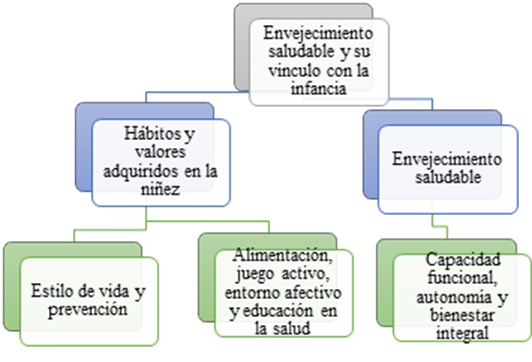
Adopting healthy habits from childhood is a key factor and a major challenge facing this country. To address this change, it is essential that gerontology healthcare professionals implement gerontoprophylaxis strategies, which will allow them to promote healthy living in order to prevent disease and decline associated with aging.
It is essential to create opportunities for health, participation, and security throughout life so that future generations can reach old age independently and autonomously. By fostering these aspects from early stages, we ensure that they can maintain their functional capacity and well-being, achieving fulfilling aging with a good quality of life, according to the Red Cross.
(Red Cross [ICRC], 2025).
Given this challenge, educational tools must be created that allow children to understand the importance of self-care, which benefits them at all stages of life through a playful and dynamic approach that strengthens knowledge and awareness to promote a culture of health. (ICRC, 2025).
In this sense, comprehensive care is a significant indicator that will allow society to age with dignity, and therefore, gerontologists have a social responsibility to fulfill. Therefore, when faced with this situation, the work of the gerontologist involves the creation of strategies aimed at gerontoprophylaxis for the promotion of aging (Aguirre, 2014) .
HEALTHY AGING
The aging of the population in Mexico, a result of the demographic transition according to the World Health Organization, presents significant challenges. Consequently, the future conditions to be met for this population must be analyzed in economic, social, emotional, and health aspects. We understand older adults to be those aged 60 and over (WHO, online).
This approach encompasses three fundamental parts: inherent capacity, environment, and the interaction between capacity and environment.
Inherent capacity refers to all physical and mental aspects of a person. Some examples are memory, mobility, vision, hearing, and emotional state.
The environment shapes a person's life and includes their home, community, public policies, and access to services. Examples include an accessible home, a community with accessible transportation, and public policies that support activity and well-being throughout a person's life.
Finally, you can see how a person with reduced mobility can age healthily if the environment is designed to support them (WHO, online).
Healthy lifestyle habits that help us live a healthier life include dietary practices, hygiene, personal care, self-regulation, interpersonal relationships, physical activity, and rest. A child's eating habits in infancy are developed throughout their life, making it crucial to lead by example. For a child to grow and develop well, both physically and mentally, it is essential to provide them with the nutrients their body needs. A healthy diet also helps prevent disease.
Healthy aging is becoming a crucial concern, which the World Health Organization defines as "the process of developing and maintaining functional capacities that enable well-being in old age." (WHO, online).
It is necessary to encourage the creation of new technical strategies, the management of pathological aging, and to ensure the full integration of older adults into the community's social fabric (Gutiérrez Robledo & Kershenobich Stalnikowitz, 2015) .
Gerontology prophylaxis has been implemented at the National DIF (System for Integral Family Development) since this demographic transition, constituting a landmark achievement in promoting healthy aging. Therefore, the need arises to continue establishing strategies and tools that contribute to achieving the main objective: promoting a healthy society that fosters healthy and optimal aging in the Mexican population.
PRIMARY GERONTOPROPHYLAXIS IN THE EDUCATIONAL PLAN
Mexico has gained notoriety for its high rates of overweight and obesity, which affect both the adult and child populations. Despite this, children are the most vulnerable group, as they have a high risk of developing non-communicable diseases at a young age. The nation's harmful habits have allowed this epidemic to spread uncontrollably among the child population.
Childhood is an exciting time, as children learn about themselves and the world around them for the first time. These are foundational years that shape many habits related to eating, personal hygiene, play, social interaction, and self-care for the rest of their lives. For educators, teachers, childcare providers, and facilitators, it is also an opportunity to help build this foundation.
Dr. Selene Bustamante Aguirre conducted research focused on promoting healthy habits. As part of this study, she led an educational intervention program whose main objective was to reduce obesity rates through the adoption of healthy eating and physical activity. However, the study was limited by considering only these indicators, so a comprehensive approach that addresses biopsychosocial factors is necessary (Gutiérrez, 2018) .
Given this situation, the health sector needs to strengthen its health promotion strategies, as it lacks tactics to encourage adherence to healthy habits. This is because its plan is designed for the medium term and does not highlight the benefits of building healthy aging from childhood (Martínez, 2021) .
As the Executive University of the State of Mexico points out, “Primary schools currently lack an educational program to prevent a negative image of the human aging process, and this perspective is one of the main factors contributing to the breakdown of intergenerational relationships, resulting in family disintegration.” Therefore, a project, “Awareness Program on Aging in Primary Schools,” was implemented. Its main objective and goal was to promote, protect, and ensure the full enjoyment of life under conditions of equality and fundamental freedom for all older adults (Gutiérrez, 2018) .
In contrast, this research focused on collecting information about perspectives, neglecting interventions to modify these stereotypes. Consequently, the work was limited to a biopsychosocial approach (Gutiérrez, 2018) ..
GUIDELINES ESTABLISHED BY THE MEXICAN GOVERNMENT FOR THE PROMOTION OF HEALTHY HABITS
Currently in Mexico and globally, we are experiencing a considerable increase in cases of childhood overweight and obesity. This is a result of the widespread distribution of ultra-processed, high-calorie products in industrialized countries, which contain abundant fats and added sugars, as well as food additives. These products are particularly obesogenic and unhealthy, and their continuous consumption negatively impacts health, leading to metabolic diseases. (INEGI, 2024).
As previously mentioned, the risk factors for these pathologies are linked to overweight and obesity, largely due to the inadequate consumption of high-calorie foods.
This phenomenon arises from our daily lifestyles, due to the accessibility of these products, which facilitates their consumption and creates a pattern of unhealthy habits (Government of Mexico, n.d.).
One of the preventative policies implemented by the government of President Claudia Sheinbaum Pardo during 2025 is based on limiting the consumption of ultra-processed foods in educational programs at the basic, upper secondary, and higher education levels.
This measure is implemented for all schools in the education system, both public and private, and its compliance is guaranteed through the corresponding educational authorities (Ministry of Health, n.d.).
The strategy is aligned with the "Healthy Living" program, which aims to address the high rates of overweight among students. Likewise, one of the expected outcomes of this initiative is to promote the consumption of healthier foods and active prevention. This national action, promoted by the Government of Mexico, aims to support the well-being and optimal health of children in the country's schools through actions focused on promoting healthy habits (Ministry of Health, n.d.).
Another contribution of the program is an online platform containing recipe books with healthy foods, aimed at parents and guardians of children, with the goal of integrating healthy habits into their lifestyles.
Through this platform, we can observe the integration of a curriculum on healthy habits, covering the following topics:
1. Healthy Eating
2. Physical Activity
3. Oral Hygiene
4. Eye Care
Each section includes the corresponding definition of each topic, as well as an activity designed to strengthen healthy habits. It also features a section titled “Did you know?” which mentions a noteworthy fact, and finally, visual resources that explain the benefits, share experiences of important figures, and propose routines that the user can implement (Ministry of Health, n.d.).
However, from a gerontological perspective based on the principles of primary gerontoprophylaxis, areas of opportunity are analyzed for integrating a biopsychosocial approach to ensure the effectiveness of the action plan being implemented (Ministry of Health, n.d.).
A key point to highlight is the passive participation of students in this project, since its focus on parents hinders the integration and adoption of healthy habits. Another relevant aspect to consider is that when integrating this program, which limits the consumption of processed foods, it should be accompanied by a manual aimed at children and integrated into the educational system for a better understanding of the topics covered. This should include playful activities that reinforce the acquired knowledge.
Another pertinent issue that must be addressed is the platform, as it lacks visually appealing materials for children, which could result in the material not being easily visible (Ministry of Health, n.d.).
Students should be supported gradually, as they have not had prior preparation for abstaining from ultra-processed foods and adapting to this new diet. This can lead to symptoms such as loss of control over eating, irritability, anxiety, and mood swings. Therefore, these adverse consequences for the psychological and emotional well-being of children must be addressed. (Ministry of Health, n.d.).
The Mexican government is promoting the National Healthy Living Strategy in public and private elementary schools across the country within the framework of the New Mexican School model. The Strategy involves coordinated actions among various institutions and specialists, including health days where students undergo various assessments, as well as:
• The integration of health education content.
• The implementation of ongoing healthy living practices.
• The organization of health fairs.
• The regulation of food sales and preparation.
These actions aim to promote the well-being of the entire school community.
Conclusions
Childhood obesity is a very complex problem to address, as it has multiple contributing factors, but family and environmental factors predominate. Therefore, developing societies are the most affected by overweight because they live in obesogenic environments where foods and products rich in empty calories are more prevalent.
From a holistic perspective, schools are the ideal forum to present proposals for fostering a culture of health among students and the school community. In this sense, from a very young age, students learn to choose their food; likewise, they must gradually assume responsibility for their health and be able to identify actions that put them at risk.
Ultimately, we must do everything possible to prevent the development of obesogenic environments, which are those factors that promote excessive weight gain in children and adolescents. Judging by the research, it is plausible to say that dietary patterns can change, but the need to develop activities that promote good nutritional habits and to include families and the community in the process will always be present.
Generally speaking, in Mexico, in recent years, social and educational strategies have been implemented to promote healthy habits in order to counteract and prevent overweight and obesity in school-aged children. However, these strategies are recent and have not been widely disseminated for many years; they still seek to address health problems with a culture of prevention and standards inherent to promoting a quality life for citizens. The transition to a healthy culture poses a significant challenge that Mexico must address, since the leading causes of death in the population stem from unhealthy lifestyles. Obesity, which is prevalent in young people and adults, and chronic diseases, which have replaced infectious diseases, paint a grim picture of the country's situation. In this regard, the education system plays a fundamental role in implementing initiatives to encourage the adoption of new eating habits and the daily development of physical activity to promote a healthy lifestyle, directly among the school population and indirectly within the school community.
Given the imminent problem of childhood obesity, the proposed solution lies in preventing the diseases that threaten children's health. This approach implies that new generations of children have the opportunity to choose a healthy lifestyle in their youth, which will ultimately allow them to avoid obesity and enjoy good nutritional and physical health in adulthood. Therefore, Health Education and Health Promotion are of paramount importance in educational and social settings.
In conclusion, the physical inactivity of Mexican society is an undeniable factor in the increasing rates of overweight and obesity among both adults and children. The repercussions of the 21st-century pandemic pose a serious public health problem because the healthcare system has proven incapable of addressing the health consequences, namely the chronic degenerative diseases associated with obesity.
In conclusion, Mexico, in general, could be a healthy society if it achieves a balance between the caloric intake and expenditure of its inhabitants. While this may seem simple, it is a very complex requirement to meet, as it involves various factors, including employment, economics, education, culture, advertising, and commerce. Consequently, it is incumbent upon the authorities to eliminate social inequalities, as they are involved in the process of achieving a better quality of life at every stage of human life.
Promoting primary gerontoprophylaxis from childhood represents a crucial commitment to building a future where healthy aging is a global priority.
References
- Aguirre S. B. Promoción de hábitos saludables para la prevención de la obesidad infantil 2014 https://gredos.usal.es/bitstream/handle/10366/127310/DDOMI_BustamanteAguirreS_Promocionhabitossaludables.pdf?sequence=1
- Comisión Internacional de Cruz Roja Los retos sociales del envejecimiento 2025 https://www2.cruzroja.es/web/ahora/retos-sociales-envejecimiento
- Gobierno de México Peligro: alimentos ultraprocesados Comisión Nacional de Salud Mental y Adicciones 2000 https://www.gob.mx/promosalud/articulos/peligro-alimentos-ultraprocesados
- Gutiérrez M. D. Hacia un programa de sensibilización sobre la vejez en escuelas primarias 2018 https://d1wqtxts1xzle7.cloudfront.net/55783211/Revista-Vision-Educativa-IUNAES-No.-24-libre.pdf
- Gutiérrez L. M. Robledo D. Kershenobich Stalnikowitz L. M. Envejecimiento y salud: una propuesta para un plan de acción 3a ed. 2015 UNAM, Coordinación de la Investigación Científica; Dirección General de Publicaciones y Fomento Editorial; Academia Nacional de Medicina de México; Academia Mexicana de Cirugía; Instituto Nacional de Geriatría
- Instituto Nacional de Estadística y Geografía Estadísticas a propósito del día internacional de las personas de edad 2022 https://www.inegi.org.mx/app/saladeprensa/noticia/7657
- Instituto Nacional de Estadística y Geografía 2024 https://www.inegi.org.mx/sistemas/olap/registros/vitales/mortalidad/tabulados
- Martínez R. L. Prevención y promoción de la salud en la vejez: Enfoques y estrategias gerontológicas 2021 Editorial Científica
- Organización Mundial de la Salud Envejecimiento saludable 2014 https://www.paho.org/es/envejecimiento-saludable
- Lorig K. Ritter P. L. Villa F. Piette J. D. Spanish diabetes self-management with and without automated telephone reinforcement Diabetes Care 31 3 408 14 2008
- Sistema Nacional para el Desarrollo Integral de la Familia Prevención de enfermedades y discapacidad, fundamental para un envejecimiento saludable 2021 https://www.gob.mx/difnacional/prensa/prevencion-de-enfermedades-y-discapacidad-fundamental-para-un-envejecimiento-saludable-266811
- Secretaría de Salud Vida Saludable Gobierno de México 2000 https://vidasaludable.gob.mx/