e-ISSN:
2683-2062
Revista Mexicana de Bioética ICSA is an online open-access journal of the Department of Medicine of the Institute of Health Sciences (ICSa) of the Autonomous University of the State of Hidalgo. It is a biannual publication released at the beginning of each period, in January and July.
The journal aims to disseminate academic, scientific, and reflective works related to bioethics, health, medical research, clinical practice, education in the health sciences, and contemporary ethical dilemmas linked to life, healthcare, research, and society.
 Open submissions Open submissions |
Indexed |
Peer reviewed |
| Open submissions |
Indexed |
Peer reviewed |
| Open submissions |
Indexed |
Peer reviewed |
Manuscripts received by Revista Mexicana de Bioética ICSA undergo a double-blind peer review process, guaranteeing the anonymity of both the authors and the reviewers throughout the process.
In a first stage, the editor conducts a preliminary review to verify compliance with the editorial guidelines and thematic relevance. Subsequently, each manuscript is sent to a minimum of two external reviewers specialized in the area, who assess the academic quality, originality, methodological rigor, and scientific relevance of the work.
Acceptance or rejection of the article is determined on the basis of the reports issued by the external reviewers, according to the following criteria:
| Reviewer 1 | Reviewer 2 | Decision |
|---|---|---|
| Positive | Positive | Accepted |
| Positive | Negative | Article sent to a third external reviewer, whose decision will be final and non-appealable |
| Positive | Conditioned, subject to changes and resubmission | The corrected article returns to the editor, who may accept or reject publication in a second review round |
| Negative | Conditioned | Rejected |
| Negative | Negative | Rejected |
After each review round, the Editorial Board will notify the corresponding author of the decision and may request additional modifications when necessary.
The arbitration reports will be sent to the corresponding author. If accepted, the manuscript will move to the editing, layout, and production stage. Final proofs will be sent to the authors for review and approval before final publication.
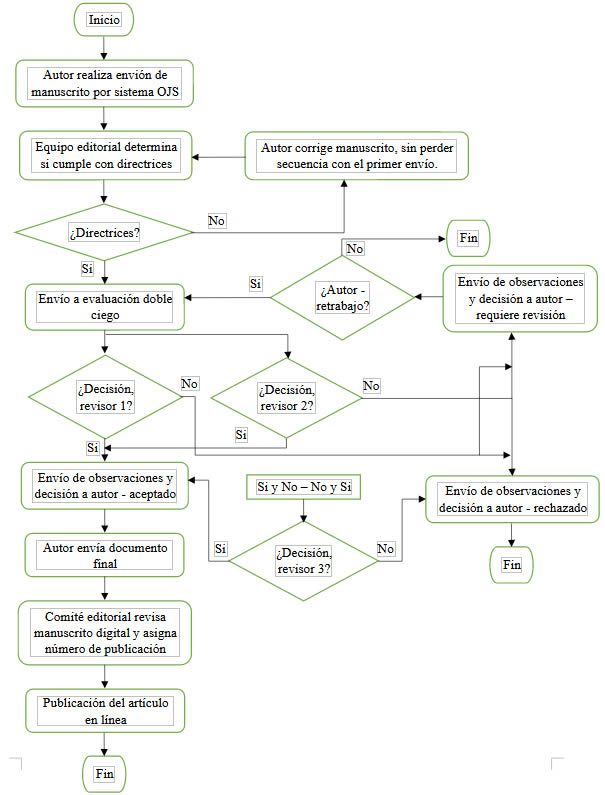
The publication process for manuscripts in Revista Mexicana de Bioética ICSA includes the following stages:
A manuscript cannot advance to a stage until the previous one has been completed, so the criteria that distinguish each stage must be clearly identified by the authors and the Editorial Board. See the Author Guide
Revista Mexicana de Bioética ICSA is a biannual publication. Its issues are published at the beginning of each period, in January and July.
The publication periods correspond to January-June and July-December.
Revista Mexicana de Bioética ICSA is an open-access journal. This means that all its content is available free of charge to users and their institutions. Users may read, download, copy, distribute, print, search, or link to the full texts of articles, as well as use them for lawful purposes, without needing prior permission from the editor or the authors, provided the terms of the current license are respected.
The journal is published under a Creative Commons Attribution-NonCommercial-NoDerivatives 4.0 International License (CC BY-NC-ND 4.0), which allows copying and distributing the material in any medium or format, under the following terms:
This policy is part of the institutional editorial guidelines applicable to the journals and scientific bulletins published by the Autonomous University of the State of Hidalgo.
The publication promotes the dissemination, preservation, and open access of scientific knowledge.
Authors retain the copyright of their published works and authorize the Autonomous University of the State of Hidalgo to publish, disseminate, preserve, and distribute the contents in accordance with the current license of the publication.
Authors may share the bibliographic reference of their published works and the official publication link provided by the publication.
Likewise, they may deposit the published version in institutional repositories, academic repositories, scientific dissemination platforms, or personal websites, provided that:
It is recommended that any later dissemination preferably point to the official version available on the UAEH institutional journal portal, in order to ensure preservation, traceability, and proper citation of the scientific content.
This policy is part of the institutional editorial guidelines applicable to the journals and scientific bulletins published by the Autonomous University of the State of Hidalgo.
The publication recognizes that Artificial Intelligence tools, including generative AI systems, writing assistants, machine translators, style correction tools, and information-organization support systems, may be used as auxiliary support during manuscript preparation.
The use of these tools does not replace the intellectual, ethical, or legal responsibility of the authors. Authors are responsible for verifying the accuracy, originality, relevance, and academic validity of all content submitted to the publication.
The use of Artificial Intelligence tools is allowed for auxiliary tasks such as spelling and grammar correction, style improvement, translation, preliminary organization of ideas, or support in the clarity of the text.
It is not permitted to use Artificial Intelligence tools to fabricate, alter, or manipulate data, generate nonexistent bibliographic references, produce results or conclusions without human supervision, or present AI-generated content as one’s own intellectual production without review and corresponding declaration.
Artificial Intelligence tools may not appear as authors or coauthors of any manuscript.
Authors must expressly declare any significant use of Artificial Intelligence tools in the preparation of the manuscript, indicating the tool used, version or model when possible, purpose of use, and scope of participation.
The publication may request additional clarification when there are indications of improper use of Artificial Intelligence tools.
This policy is part of the institutional editorial guidelines applicable to the journals and scientific bulletins published by the Autonomous University of the State of Hidalgo.
The publication promotes the principles of Open Science through practices that encourage transparency, reproducibility, and the responsible reuse of scientific knowledge.
Authors are encouraged to share data sets, supplementary materials, instruments, code, transcripts, or other resources derived from the research whenever possible and appropriate according to the nature of the work.
Materials may be deposited in recognized institutional, thematic, or academic repositories, preferably including the corresponding reference within the manuscript.
When ethical, legal, confidentiality, personal data protection, third-party rights, or institutional agreements prevent the sharing of information, authors must state this explicitly in the manuscript.
Data availability will be assessed considering the nature of each study, disciplinary particularities, and respect for the applicable ethical principles.
This policy is part of the institutional editorial guidelines applicable to the journals and scientific bulletins published by the Autonomous University of the State of Hidalgo.
External authorship is understood as authorship made up of authors whose main affiliation does not correspond to UAEH. When a manuscript includes mixed authorship, the external character will be determined based on the main affiliation declared by each author at the time of submission.
The publication will promote the participation of external authorship as part of academic openness, interinstitutional collaboration, and disciplinary diversity.
For editorial follow-up purposes, each journal or bulletin will publish an annual verifiable external authorship report that will include, at a minimum, the evaluated period, the total number of published articles, the total number of articles with at least one external author, the total number of signing authors, the total number of external authors, and the calculation method used.
The suggested institutional indicator will be the following:
Percentage of articles with external authorship = (number of articles published in the period that include at least one author with affiliation external to UAEH / total number of articles published in the period) x 100.
The journal may complement this indicator with the percentage of external authors relative to the total number of signing authors.
The annual report must be available on the journal or bulletin website and may be linked from the Editorial Policies section, Announcements, or an institutional repository.
This policy is part of the institutional editorial guidelines applicable to the journals and scientific bulletins published by the Autonomous University of the State of Hidalgo.
The publication will request that manuscripts include a brief section titled “Social relevance”, “Social impact”, or an equivalent phrase, in which the academic, social, community, institutional, or professional usefulness of the study is clearly explained.
As appropriate, that section should indicate which problem the research addresses, which population or sector benefits, what contribution it makes, and what its disciplinary, territorial, or community scope is.
The length may be brief and adjusted to the nature of each discipline or article type.
In addition, the editorial presentation of each issue may include a summary of the social value of the published works and their possible use by academic, professional, or social communities.
This information must be incorporated into the author guidelines and the corresponding manuscript template.
This policy is part of the institutional editorial guidelines applicable to the journals and scientific bulletins published by the Autonomous University of the State of Hidalgo.
The journal or bulletin will develop public communication and scientific outreach actions to give visibility to calls for papers, editorial processes, published issues, and research results.
Dissemination actions may include announcements in OJS, institutional microsites, support websites, institutional social networks, electronic bulletins, outreach notes, infographics, interviews, information capsules, and other outreach pieces approved by the editorial team.
Whenever possible, each dissemination action should include a publication date, link, responsible person or issuing area, and evidence of dissemination.
The publication will seek to ensure that public communication always refers to the official version available on the institutional portal, in order to preserve traceability, proper citation, and editorial integrity.
Journals and bulletins may keep an annual record of public communication activities as evidence of compliance.
This policy is part of the institutional editorial guidelines applicable to the journals and scientific bulletins published by the Autonomous University of the State of Hidalgo.
The publication adopts the Web Content Accessibility Guidelines (WCAG) 2.1 AA as the technical reference for the progressive review of its website, theme, plugins, forms, images, navigation, and PDF documents.
Compliance is not presumed simply because the platform uses OJS 3.3.0-20 or the default theme; any compliance statement must be supported by documented technical verification of the specific installation.
The journal or bulletin will conduct periodic accessibility reviews and record the barriers detected, the corrections applied, and the remediation status.
When an inherited technical barrier cannot be corrected immediately, the publication will document the limitation and establish improvement actions as a priority.
As part of this policy, the publication will seek to ensure that published content follows minimum accessibility best practices, including sufficient contrast, semantic heading structure, keyboard navigation, alternative text for images, form labels, readable text, and PDF documents prepared for accessible reading.
The publication may issue an accessibility status statement once the corresponding technical review has been completed.
Accessibility status of the installation:
The journal is currently under technical review regarding its OJS installation, templates, and PDF documents. At this time, there is insufficient evidence to declare full compliance with WCAG 2.1 AA. Any compliance statement must rely solely on documentary evidence resulting from that review.
The publication recognizes that web accessibility is part of a continuous improvement process. In this context, the progressive migration to newer versions of the platform OJS is under evaluation, as they incorporate functional and technical improvements that may favor site accessibility and its components.
At present, the update to a newer version is conditioned by technical dependencies and legacy incompatibilities resulting from previous migrations, which are being addressed by the responsible team.
While this process is completed, the journal will maintain review, correction, and remediation measures on the current installation in order to reduce access barriers and document the actual accessibility status of its portal.
Revista Mexicana de Bioética ICSA declares its commitment to academic integrity, editorial transparency, and good scientific publishing practices. This code must be observed by authors, reviewers, editors, and all people involved in the editorial process.
Authors' commitments
Reviewers' commitments
Editors' commitments
Revista Mexicana de Bioética ICSA adheres to the basic practices of the Committee on Publication Ethics (COPE): https://publicationethics.org/.
If the manuscript is accepted for publication, the authors retain the copyright of their published articles without restrictions and permanently grant Revista Mexicana de Bioética ICSA, on a non-exclusive basis, the right to publish, reproduce, distribute, display, and disseminate their work nationally and internationally, in order to preserve it and make it available in open access, in whole or in part, through current institutional digital media and channels, databases, repositories, and academic portals, under the applicable publication license.
The authorship of manuscripts must be fully defined from the initial submission stage through the OJS platform. The inclusion, removal, or reordering of authors, as well as a change of corresponding author, may only be considered during the manuscript evaluation phase, provided that this situation has been formally notified by the corresponding author before final acceptance and includes the corresponding justification.
Once the manuscript has been accepted and published, no changes in authorship will be allowed, except in duly documented exceptional cases, which will be evaluated in accordance with the guidelines of the Committee on Publication Ethics (COPE). Requests for post-publication authorship changes motivated by external administrative, institutional, or academic requirements do not constitute a valid criterion for editorial changes and may be rejected in order to safeguard the integrity, transparency, and credibility of the publication.
Revista Mexicana de Bioética ICSA does not charge article processing charges (APCs). This includes:
All manuscripts submitted to Revista Mexicana de Bioética ICSA will be checked with similarity and plagiarism detection tools such as EduBirdie, Plagius, and Plag, with the purpose of analyzing matches and verifying the originality of the texts.
This review will be carried out by the editor-in-chief upon receipt of the submission and before starting the peer review process. If plagiarism or self-plagiarism is detected in a manuscript submitted for publication, the procedure recommended by COPE will be followed, according to the following diagram.
Revista Mexicana de Bioética ICSA follows the recommendations of the Committee on Publication Ethics (COPE) regarding corrections, retractions, and republications, with the aim of preventing bad scientific practices and maintaining the integrity of the academic record. The journal may publish corrections, clarifications, or retractions when necessary.
The correction or retraction document must indicate the title of the affected manuscript, volume, issue, year of publication, causes of the correction or retraction, original publication date, and correction or retraction date. When applicable, it must include validation by the editor-in-chief.
The online publication and DOI of the manuscript will be maintained when necessary to preserve the traceability of the academic record. If relevant, the organizations, indexes, and databases where the journal is registered will be notified.
The publication adopts a metadata policy aimed at ensuring interoperability, editorial traceability, correct citation of published works, and permanent retrieval of its content.
The publication uses Dublin Core as its main interoperability scheme through OAI-PMH, with public access to its harvesting endpoint at the following address:
https://repository.uaeh.edu.mx/revistas/index.php/MBR/oai
This implementation enables metadata harvesting and exchange with indexing, aggregation, and bibliographic preservation systems.
Every submitted manuscript and every published article must record, at a minimum, the following metadata:
When the type of manuscript requires it, other metadata may also be mandatory, such as funding, conflict of interest statement, data availability, acknowledgments, and editorial notes.
Metadata are initially captured by the authors during the submission process in OJS.
Subsequently, the review and validation of metadata is the responsibility of the editorial team. In particular:
Editorial validation must confirm that the published metadata match the final accepted manuscript, the corresponding authorization or transfer letter, and the version published in OJS.
If a metadata error is detected after publication, the publication will apply the editorial mechanism proportionate to the type of error.
If the detected problem compromises the integrity of the editorial record, authorship, originality, or validity of the content, the case will be assessed in accordance with COPE guidance on corrections, expressions of concern, and retractions.
The publication may progressively incorporate multiformat export processes from the editorial source file, based on a conversion and validation methodology that ensures consistency between the original and its derivative outputs.
The publication is committed to ensuring that its metadata are complete, verifiable, consistent, interoperable, and traceable for correction when a legitimate error exists.
Committed to the timely dissemination of scientific research and innovation results, Revista Mexicana de Bioética ICSA may present accepted manuscripts for publication, after the double-blind peer review process has been completed, in postprint form.
These manuscripts will later appear in their final version within a specific issue of the journal. In that final version, information related to volume, issue, publication date, and pagination may be updated. Each postprint may have its own Digital Object Identifier (DOI), which may be used for citation and reference purposes in accordance with the publication's editorial policies.
To ensure the integrity, accessibility, and long-term preservation of published content, this journal implements various digital preservation strategies. In particular, it actively participates in the following initiatives:
These tools make it possible to preserve articles and editorial materials through distributed and secure copies, reinforcing the journal's commitment to the continued availability of scientific knowledge.
Our journal is indexed in various recognized platforms. You can consult them here.
2683-2062
Recibido - Aceptado









This work is under a Creative Commons Attribution-NonCommercial-NoDerivatives 4.0 International License